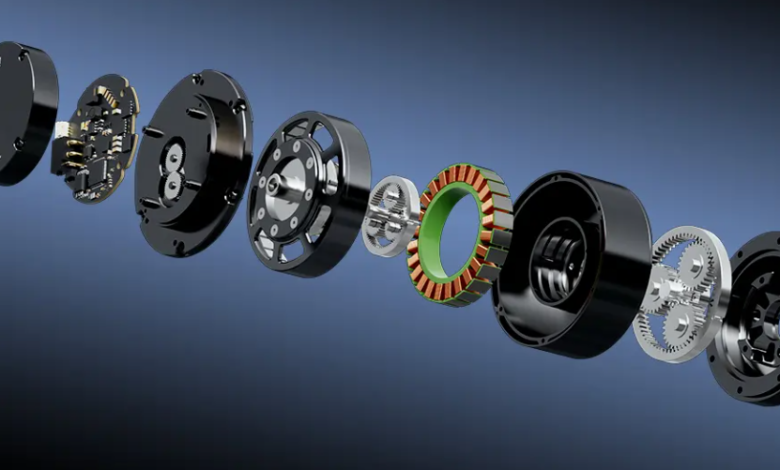
A humanoid robot can look powerful in a short demo, but real work creates a different problem: heat.
Walking, squatting, balancing, lifting, and carrying all place repeated load on the motors inside the robot’s joints. A motor that performs well for a few minutes may lose torque, trigger current limits, or become unstable when heat builds up during continuous operation.
This is why thermal management is becoming one of the most important issues in humanoid robot motor design. The challenge is not simply making the motor stronger. It is making the motor strong enough, compact enough, and cool enough to keep working under real duty cycles.
For humanoid robots moving from research labs to factories, warehouses, and service environments, heat control may decide whether a motor is only good for demonstration or ready for long-term use.
The Real Test Is Continuous Operation
Peak torque gets attention, but continuous operation is the harder test.
A humanoid robot motor may need to support repeated walking cycles, balance corrections, arm movement, and object handling. These actions do not happen once. They happen again and again.
When current flows through the motor windings, heat is produced. When the joint accelerates, brakes, or holds a load, more heat can build up. If the motor is packed inside a compact joint with limited airflow, that heat becomes difficult to remove.
This is why thermal design must be considered early. It cannot be added as a quick fix after the robot is already designed.
Where the Heat Comes From
Motor heat is not caused by one thing. It comes from a combination of electrical and mechanical losses.
Common sources include:
- winding resistance
- high current during heavy load
- repeated acceleration and braking
- friction in bearings or reducers
- compact housings with poor airflow
- long walking or lifting cycles
- heat from nearby drivers or electronics
Leg joints usually face the heaviest thermal load. The hips, knees, and ankles support body weight and handle constant balance corrections. Arm joints may heat up during carrying, pushing, tool handling, or repetitive work.
Heat becomes especially difficult when several parts are integrated into one joint module. The motor, reducer, encoder, driver, and wiring may all sit close together.
Why Overheating Changes Robot Performance
When a motor gets too hot, the robot may not fail immediately. But performance can change.
The controller may reduce current to protect the motor. Torque output may drop. Position feedback may become less stable if nearby sensors are affected by temperature. Lubricants and bearings may also experience more stress over time.
| Thermal Problem | Possible Result |
| Motor overheating | Torque reduction or shutdown |
| Driver heat buildup | Less stable control |
| Encoder temperature drift | Reduced position accuracy |
| Bearing stress | Shorter joint life |
| Uneven joint heating | Inconsistent motion |
| Repeated thermal cycling | Long-term reliability issues |
For a humanoid robot, this can affect walking, balance, lifting, and task completion. A robot that slows down after a short period may be acceptable in a lab test, but not in a working environment.
High Torque Density Makes Cooling More Difficult
Humanoid robots need compact, high-torque joints. That creates a direct thermal challenge.
A smaller motor has less surface area to release heat. A more powerful motor generates more heat under load. A sealed or compact joint gives heat fewer places to go.
This creates a design trade-off:
- A larger motor may run cooler but adds weight.
- A smaller motor saves space but may heat faster.
- Higher torque density improves strength but increases cooling pressure.
- Better integration saves space but can trap heat.
Engineers need to look at continuous torque, duty cycle, and heat path, not just motor size or peak output.
Which Humanoid Robot Joints Need the Most Thermal Attention?
Different joints heat up in different ways.
Hip Joints
Hip motors support leg swing, posture control, and balance recovery. They often carry high loads during walking and turning.
Knee Joints
Knee motors handle repeated bending, standing, squatting, and load support. They are one of the most demanding joints during continuous walking.
Ankle Joints
Ankle motors make frequent balance corrections. Even if the peak torque is not always the highest, the duty cycle can be intense.
Shoulder and Elbow Joints
These joints become thermally important when the robot lifts, carries, pushes, or performs repetitive arm tasks.
Understanding these differences helps engineers decide where stronger cooling paths or larger thermal margins are needed.
How Engineers Can Improve Thermal Management
Thermal management is not just about adding fans. In humanoid robots, space is limited, and airflow may be poor. The solution usually needs to be built into the joint architecture.
Useful strategies include:
- creating a clear heat path from the stator to the housing
- using thermally conductive materials in the joint structure
- spreading heat through the outer shell
- separating sensitive sensors from hot zones
- monitoring motor temperature in real time
- limiting current during long high-load tasks
- optimizing gait to reduce unnecessary torque demand
- selecting motors based on continuous load, not only peak torque
Software can also help. The robot can change its movement pattern, reduce acceleration, shift load between joints, or slow down before temperatures reach unsafe levels.
A Real-World Scenario: Walking Through a Warehouse
Imagine a humanoid robot walking through a warehouse for inspection or light material handling. At first, everything works well. The hips and knees generate torque with each step. The ankles make constant balance corrections. The arms may carry small objects or hold tools.
After a long period, heat builds up.
If thermal design is weak, the robot may reduce speed, lose torque margin, or need to stop. If one joint heats faster than the others, the walking pattern may become less stable. If heat affects feedback components, control quality may drop.
Good thermal management helps prevent this. It allows the robot to keep working longer and move more consistently.
Why Thermal Design Will Shape Humanoid Robot Adoption
As humanoid robots move toward real applications, users will care less about short demos and more about uptime. Can the robot walk for long periods? Can it carry objects repeatedly? Can it work without constant cooling breaks? Can it maintain stable motion across a full shift?
These questions all connect to thermal performance.
A powerful motor that overheats quickly may not be useful in the real world. A balanced motor system with stable heat behavior may deliver better practical value, even if its peak numbers look less dramatic.
Final Thoughts: Heat Control Decides Real-World Performance
Humanoid robot motors must be powerful, compact, responsive, and reliable. Thermal management connects all of these requirements.
Without good heat control, high torque density can become a weakness. With better thermal design, humanoid robots can walk longer, lift more consistently, and perform real tasks with fewer interruptions.
For the next stage of humanoid robot development, motor heat is not a minor detail. It is one of the key engineering challenges that will decide whether robots can move from impressive demonstrations to dependable daily work.