Ever stared at a production plan and felt uneasy about it? On screen, everything lines up nicely. In reality, machines stall, people scramble and deadlines slide. That gap between plan and reality is where Capacity Requirement Planning either proves its value or quietly lets things fall apart.
So why does it fail so often? More importantly, how do you fix it so it actually supports the business instead of creating false confidence? Let’s walk through it step by step.
Understanding Capacity Requirement Planning Without the Noise
Capacity Requirement Planning is not about fancy formulas or complex dashboards. It is about one practical question. Do we have the people, time and equipment to deliver what we promised?
CRP compares the planned workload against the real available capacity. It examines the efficiency of labour shifts and downtime in machines. When done properly, it exposes constraints before they turn into missed deliveries.
When done poorly, it becomes a report that everyone ignores.
AI Overview of Capacity Requirement Planning
Capacity Requirements Planning, or CRP, is a structured way to verify whether production plans are realistic. It uses information from Material Requirements Planning to calculate the workload for each work centre.
CRP checks planned order routing times and work centre availability. It then compares the total load with the actual capacity. If demand exceeds capacity, it flags bottlenecks. If capacity exceeds demand, it highlights underuse.
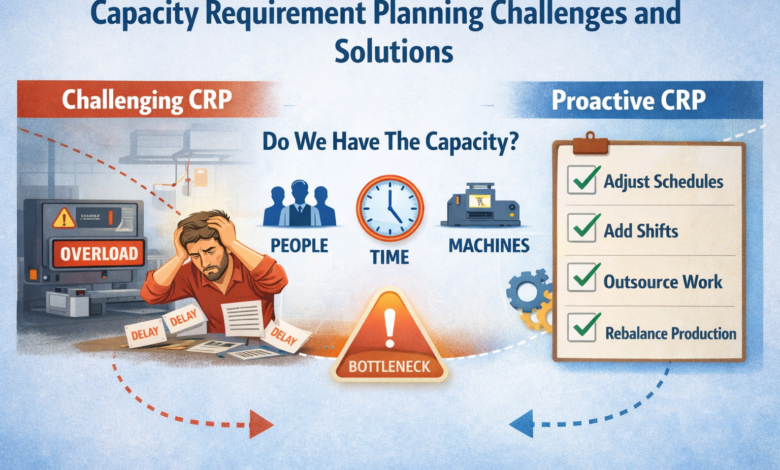
Based on these findings, teams can adjust schedules, add shifts, hire staff, outsource work or rebalance production. In simple terms, CRP answers a tough but necessary question. Can we actually make this work?
Why Capacity Requirement Planning Breaks Down
CRP rarely fails because of maths. It fails because of assumptions.
Routing times are outdated. Efficiency is overstated. Maintenance downtime is ignored. Plans assume everything runs smoothly. It never does.
Another common issue is timing. CRP is often run after sales commitments are locked in. At that point, it cannot guide decisions. It only reports problems.
There is also a disconnect between planners and operators. The plan lives in software. Reality lives on the shop floor. When those two worlds do not talk, CRP loses credibility fast.
The Real Importance of Capacity Requirement Planning
The importance of capacity requirement planning shows up when pressure rises.
Without it, teams react instead of plan. Overtime spikes. Orders slip. Customer trust erodes.
With strong CRP teams, see trouble early. They shift work before bottlenecks form. They protect delivery dates. They use resources more evenly.
CRP does not slow operations. It removes surprises.
CRP and MRP Explained in Plain Terms
MRP and CRP are often confused. They serve different purposes.
Material Requirements Planning focuses on materials. It determines what to produce and when, based on demand.
Capacity Requirement Planning focuses on capability. It answers whether machines and people can handle that plan.
Together, they form a reality check. MRP builds the plan. CRP validates it. Ignoring CRP after MRP is like scheduling a flight without checking runway availability.
The Five Core Steps of Capacity Planning
Capacity planning follows a clear flow.
First, calculate the load. Determine how many hours each order requires at each work centre.
Second, measure the available capacity. Account for shifts, downtime efficiency, and maintenance.
Third, compare load and capacity. Identify overloads and idle resources.
Fourth, evaluate options. Look at staffing shifts, outsourcing or schedule changes.
Fifth, adjust the plan and monitor results.
This cycle repeats continuously. Capacity planning is not a one-time exercise.
A Practical Capacity Requirement Planning Example
Let’s look at a simple capacity requirement planning example.
A plant plans to build 400 units next month. Each unit needs three hours on a key machine. That creates 1200 hours of load.
That machine runs one shift five days a week. It provides roughly 640 hours per month.
CRP immediately reveals a shortfall. Without CRP, this issue appears halfway through the month. With CRP, the team can act early by adding shifts, subcontracting, or revising commitments.
Types of Capacity Requirement Planning
There are several types of capacity requirement planning depending on how detailed you need to be.
Rough cut planning checks the feasibility at a high level. It is useful early in planning.
Detailed CRP works at the work centre level using exact routing data.
Finite capacity planning respects hard limits. Infinite planning assumes flexibility.
Problems arise when teams rely on rough estimates too late or expect detailed plans too early.
Difference Between Rough Cut Capacity Planning and Capacity Planning
The difference between rough-cut capacity planning and capacity planning comes down to timing and detail.
Rough-cut planning tests big assumptions before plans are finalised.
Detailed CRP validates execution once schedules take shape.
Think of rough-cut planning as a preview. CRP is the commitment.
Defining Capacity Requirements Clearly
Capacity requirements represent the total resources needed to meet production goals. That includes labour hours, machine time, setup effort, and support functions.
Ignoring any of these distorts the picture.
Capacity is not just equipment. Skilled people matter just as much.
Strategies for Adjusting Capacity When Gaps Appear
CRP only helps if teams act on it.
A capacity lead strategy adds resources ahead of demand. It reduces risk but raises cost.
A capacity lag strategy waits until demand is proven. It controls cost but increases pressure.
An average strategy balances both approaches.
There is no universal best choice. The right strategy depends on demand volatility and service expectations.
Why Human Judgment Still Matters in CRP
Software calculates numbers. People interpret them.
Only humans understand which orders are strategic. Only operators know which machines are fragile. Only managers can weigh overtime against outsourcing.
CRP works best when planners and floor leaders review results together. Planning should be a conversation, not a static report.
Using Capacity Requirement Planning PDFs and PPTs Wisely
Many teams start with a capacity requirement planning PDF or a capacity requirement planning PPT to learn the basics. These tools help explain concepts.
What matters more is daily discipline. Spreadsheets, dashboards, and regular reviews drive results. Slides do not.
Documentation supports planning. It never replaces it.
Capacity Requirement Planning Beyond Manufacturing
CRP applies far beyond factories.
Warehouses use it to plan labour space and throughput. Resources like Find the Perfect Warehouse in Dubai for Your Business highlight how capacity visibility shapes logistics decisions.
Engineering organisations rely on CRP to manage skilled teams. That discipline helps explain trust in firms such as Why NASA Trusts Millennium Engineering and Integration.
Energy systems also demand careful capacity planning, as shown in complex operations like A Clear Look at Invinity Energy Systems.
Capacity constraints exist everywhere. CRP makes them visible.
How to Make Capacity Requirement Planning Actually Work
Here is what changes everything.
Keep routing data current.
Run CRP before commitments, not after.
Involve operations early.
Treat CRP as a decision tool, not a formality.
When planning reflects reality, execution improves naturally.
Bottom Line
Capacity Requirement Planning fails when it is treated as software output. It succeeds when it is treated as a habit.
It does not eliminate uncertainty. It exposes it early.
That is its real power.
FAQs
What do you mean by capacity requirement planning?
Capacity requirement planning is the process of checking whether available resources can support planned production. It compares workload with real capacity to prevent overloads or idle time.
What are the five steps of capacity planning?
They include calculating load, measuring capacity, comparing gaps, evaluating options, and adjusting the plan.
What are the capacity requirements?
Capacity requirements are the total labour, machine, and time resources needed to meet production objectives.
What are CRP and MRP?
MRP plans materials. CRP verifies whether capacity exists to process those materials into finished goods.
What are the 4 types of planning?
Strategic, tactical, operational, and capacity planning work together to guide execution and long-term success.