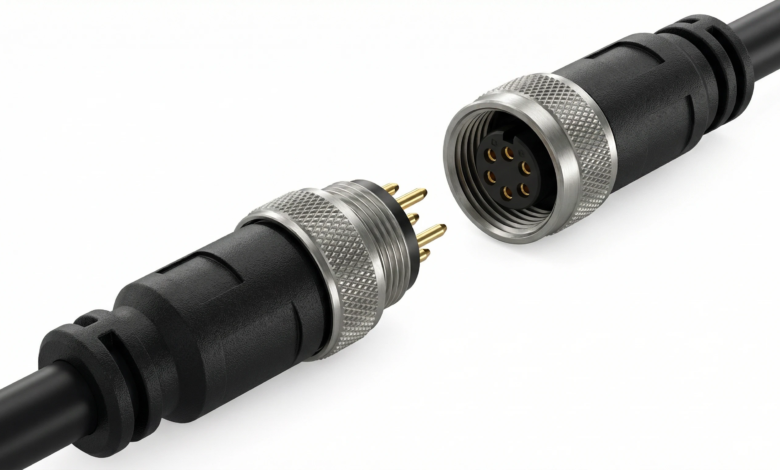
Every day, electronic connectors are widely used to join electrical circuits together. These electro-mechanical devices, consisting of conductive terminals within an insulating housing, create a temporary or permanent, separable interface to transmit power, data, or signals.
Connectors are not, however, all the same. Whether you’re a hobbyist building a PC or an engineer specifying parts for a production line, you will need to understand pin configurations and ratings to ensure safety, compatibility, and performance across your projects.
If you were to select the wrong connectors for a particular job, this could lead to such dire consequences as overheating, equipment damage, fire, and/or electric shock.
This guide, then, could be essential reading for you. Aimed chiefly at UK readers, but with largely applicable relevance to audiences in other parts of the world, this article will set out the key concepts and details that both professionals and amateurs need to grasp on this topic.
- Pin Configurations: The ‘Map’ Of the Connector
A connector’s pin configuration is also sometimes referred to as its “pin layout” or “pinout”. It defines the number of pins/contacts, as well as their physical arrangement, shape, and which pin carries live (phase), neutral, earth (ground), or other signals.
Here are some key aspects of a connector’s pin configuration that you should understand:
- Pitch. This is the distance between the centre of one pin and the centre of the next. Examples of common sizes include 2.54mm, which is standard for breadboards, and 1.27mm for high-density applications.
- Keying. To guard against the risk of “mismating” – in other words, a given connector being plugged in the wrong way – many such components in the UK use physical notches or shapes so that they only fit one way.
- Numbering. It is common for the manufacturers of electronic connectors to number pins from left to right or clockwise. Checking the datasheet is crucial, as “plug” (male) and “socket” (female) numbering are often mirrored.
- Understanding Electrical Ratings
Pushing too much energy through a small pin constitutes a fire hazard. Electrical ratings, then, play an imperative role by specifying safe limits.
The three main ratings to watch as far as connectors are concerned, are:
- Current rating (amps). This refers to the maximum amount of current a single pin is able to carry continuously without overheating. If, for example, you require 10A but the connector you use is only rated for 5A, this presents a risk of melting the housing.
- Voltage rating (volts). This defines the maximum voltage the insulation between pins can handle before an electrical arc happens. If you’re working on a UK mains project, it is vital to make sure your chosen connector is rated for at least 250V AC.
- Contact resistance. This term refers to the resistance to electrical current flow at the interface of two contacting conductors, such as switches, connectors, or bolted joints. It is typically measured in milliohms (mΩ), with a lower rating being better. High resistance leads to a buildup of heat, as well as signal loss.
- British Standards and IP Ratings
In the UK, environmental protection is often no less important than electrical capacity.
This makes it crucial to be well-informed on such aspects as:
- IP ratings. If the connector that you require will be used outdoors or in damp British weather, you should be looking for IP67 (waterproof) or IP68 (submersible) options.
- BS EN standards. By seeking out connectors that adhere to BS EN 60603 or similar British/European standards, you can make sure the plastics are flame-retardant and the tolerances are precise.
Arming Yourself with Knowledge on Pin Layouts and Ratings Will Be a Wise Investment
Grasping the essentials of pinouts and electrical ratings will greatly help you to choose safe, compatible electronic connectors for your projects, while avoiding common pitfalls.
Whatever components you ultimately select for your latest application, it is crucial to always check that voltage and current ratings match your appliance and supply. This will put you in a strong position to ensure safety and compliance with UK electrical standards.